
What Is PAT Testing?
What it is, what the law actually asks for, and exactly what you get when we visit.
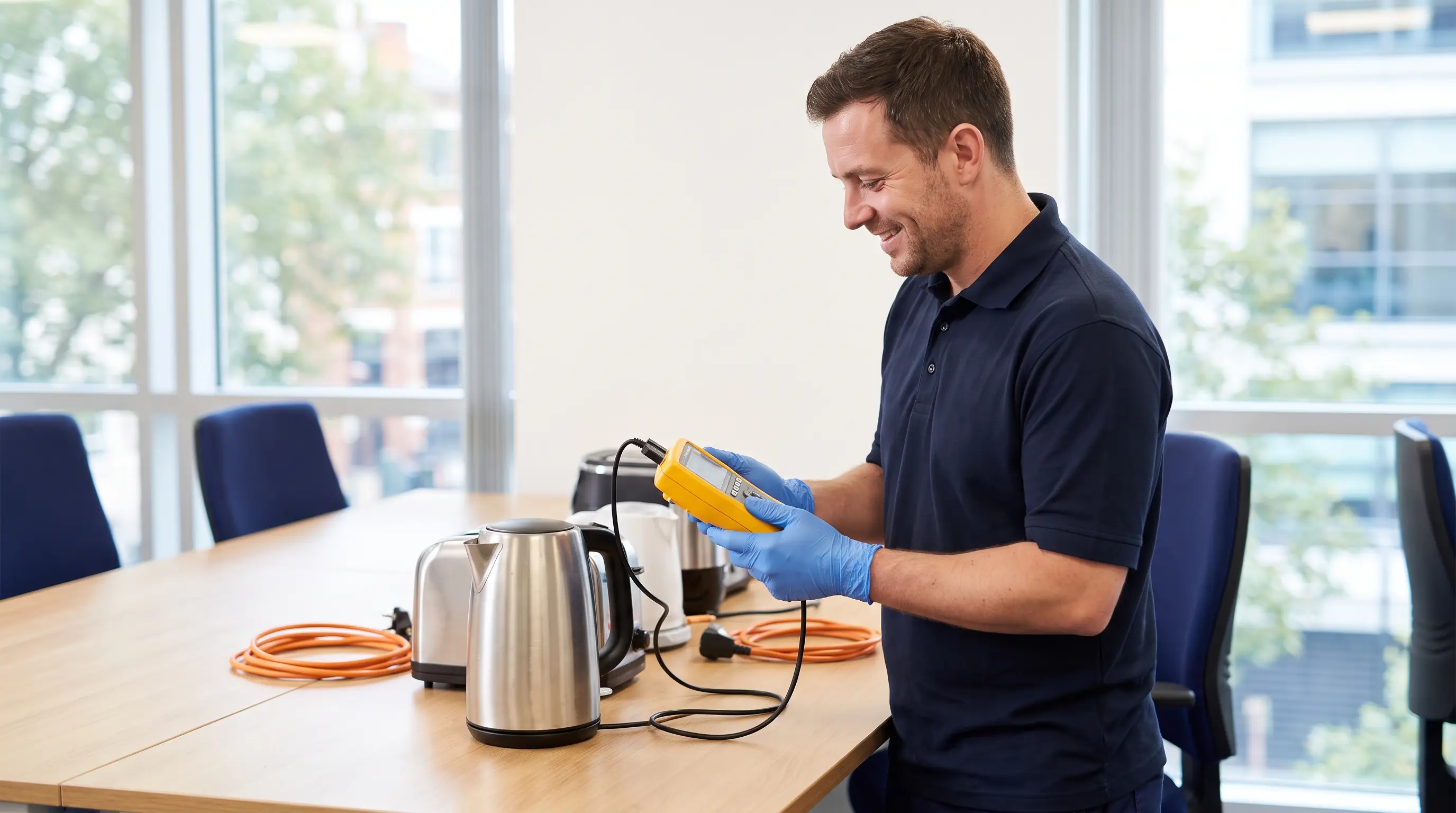
What is PAT testing?
PAT stands for portable appliance testing, sometimes called in-service inspection and testing. It combines a visual inspection (checking the plug, cable and casing for damage) with electrical tests using calibrated equipment. Each item gets a pass or fail label, and you receive a certificate and itemised report.
PAT testing, EET and in-service inspection
You will see the same service under several names. PAT testing is the one most people know. The IET Code of Practice, the industry standard testers work to, calls it in-service inspection and testing of electrical equipment, and its current fifth edition, published in 2020, dropped the words "portable" and "appliance" from the main text, because the duty covers any electrical equipment rather than only things with a plug. Some firms and training bodies have since started calling it EET, short for electrical equipment testing.
It is the same job under a different label. The law behind it has not changed, the checks are the same, and a certificate headed PAT is just as valid as one headed EET. If a letting agent or insurer asks you for an EET certificate, our itemised PAT certificate covers the same inspection and tests.
Is it a legal requirement?
There's no law that says you must PAT test every year. What the law requires is that electrical equipment is maintained so it doesn't cause danger, and that duty comes from the Electricity at Work Regulations 1989. Insurers and the IET Code of Practice treat regular inspection and testing as the expected way to meet it, so in practice most businesses, landlords and venues have it done.
How often should you test?
It depends on the equipment and the environment. A kettle in a busy café or a power tool on a building site needs testing far more often than a monitor that never moves. We'll recommend sensible intervals for your premises so you aren't paying to test more often than you need.
What you get with us
- Travel within 30 miles of Banbury and no call-out fee (further out, £1 a mile beyond the first 30)
- A pass or fail sticker on every appliance
- Minor repairs carried out on the spot (any parts, such as plugs and fuses, are charged separately)
- A PDF certificate and full itemised report, emailed the same day
Also available
As well as standard PAT testing, we test equipment for events and production companies, and we carry out microwave leakage testing. Tell us what you need when you book. We can also test in the evening or overnight if your premises can't shut during the day, at an out-of-hours rate.
More plain-English answers, and a free appliance register to download, are in our PAT testing guides.
What we can and cannot test
Worth reading before you book, so there are no surprises on the day. These rules are part of our terms of business.
Equipment Access & Testing Disclaimer
PAT testing is carried out on accessible, freestanding electrical equipment where the plug and cable can be safely accessed.
We do not dismantle, move, disconnect or otherwise interfere with fixed or integrated equipment where the plug or electrical connection is not readily accessible.
If an item cannot be safely accessed or moved due to its weight, position, risk of damage to flooring or the item itself, or a risk of injury to our technician, a full PAT test may not be possible. In these circumstances, a visual inspection will be carried out where reasonably practicable, and the item will be recorded as visually inspected rather than electrically tested.
We will not move equipment where doing so could reasonably result in injury, damage to the equipment, surrounding property or flooring.
Heavy or Difficult-to-Move Equipment
We do not routinely move, lift or reposition heavy, bulky, awkward or specialist equipment where doing so would require additional personnel, specialist lifting equipment or create a risk of injury or damage.
Where an item requires more than one person to move safely, the customer is responsible for providing suitable assistance and personnel to make the equipment safely accessible for testing.
Our technician will not undertake lifting or moving that they consider unsafe, excessive or outside the normal scope of PAT testing.
If suitable access cannot be provided, the equipment will receive a visual inspection where reasonably practicable and will be recorded accordingly.
The customer is responsible for providing safe and reasonable access to equipment that requires testing.
Is PAT testing a legal requirement in the UK?
PAT testing is not named in any single law, and there is no law that says you must test appliances at a set interval. What the law does require is that electrical equipment is kept safe. The Electricity at Work Regulations 1989 place a duty on employers, the self-employed and those in control of premises to maintain electrical equipment so it doesn't cause danger.
In practice, regular in-service inspection and testing (PAT) is the recognised way to meet that duty. Insurers and the IET Code of Practice treat it as the expected standard, which is why most businesses and landlords have it done.
How often should appliances be PAT tested?
There is no fixed legal interval. The right frequency depends on the type of equipment and the environment it's used in. Higher-risk items that get moved around, like power tools, extension leads and kettles, are tested more often than low-risk, stationary equipment such as a desktop monitor.
As a rough guide, many offices and shops test annually, while construction and hire equipment may be tested every few months. We'll advise the right interval for your premises when we visit, so you're not paying to test things more often than you need.
What's included in the price?
Everything you'd expect for a compliant test: travel to your premises (free within 30 miles of Banbury), visual inspection and electrical testing of each appliance, a pass or fail sticker on every item, minor repairs on the spot, and a PDF certificate with a full itemised report emailed the same day. Any parts we fit, such as new plugs or fuses, are charged separately.
Ready to get tested?
Pick a slot in the next four weeks, or send us the details for a date further out. It's a provisional booking, and one of the team will be in touch to confirm.